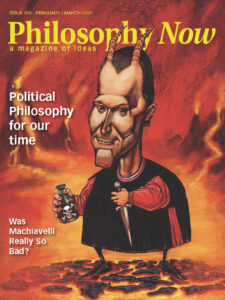
Book review of Reality Unbound: The Digital Mind (and the Nature of Reality) by E. Hughes is printed in the February-March 2025 Philosophy Now Issue #166 on the inside back cover. If you love philosophy, order your copy or a subscription of this excellent magazine (click the magazine cover for a link to Philosophy Now). The review of Reality Unbound is also syndicating on Explore Authors Magazine.
Check for local events and online philosophical discussions on RealityUnbound.org
Eric Hoffer Grand Prize Finalist (2025)
Paperback ISBN: 978-1-961823-28-0
eBook ISBN: 9781961823273
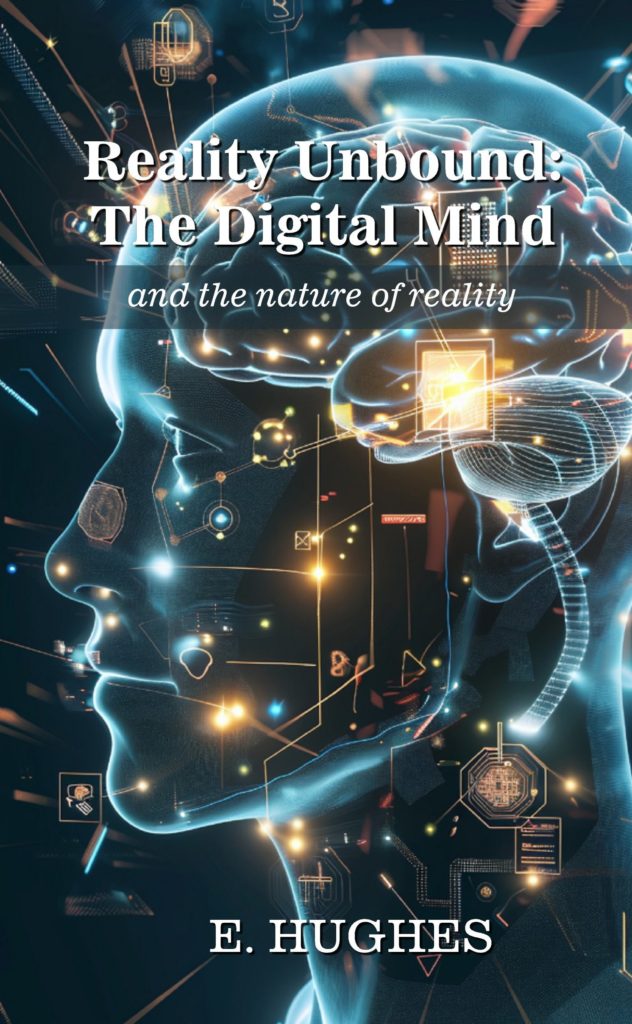
Title: Reality Unbound: The Digital Mind (and the nature of reality)
Author: E. Hughes
Genre: Non-fiction, philosophy, science
Availability: Paperback, eBook
Google Books (click here)
On Booklife
On Explore Authors Magazine
Amazon | Barnes and Noble | ThriftBooks | Walmart | Books-a-Million | Blackwell’s | Abe Books |Alibris | Gramercy Books | The Plains Trading Company | Book Tenders | Bookshop.org |Chaucer’s Books | Wordup Bookstore | Biblio | Booktopia | Amazon UK | BooksWagon | Better World Books | City of Asylum Books | Prairie Lights Books | Strand Books | Better World Books | An Unlikely Story | Warwicks | The Reading Bug | Avid Bookshop | New York City Strand | McNally Jackson | Powell’s | San Marco Bookstore | Eagle Harbor Book Company | Moby the Great |
Where to buy: eBook
Amazon | Barnes and Noble | Kobo | eBooks.com | Indigo
About the Book:
Reality Unbound: The Digital Mind (and the nature of reality) explores boundaries between human and artificial intelligence and the nature of perception and reality.
Is the mind digital? Is the existence of the mind or consciousness a cosmic accident or did nature design the first software program and central processing center in the human brain, thus designing intelligence in organisms for a specific metaphysical, evolutionary, or cosmic purpose? Or was it random? Better—how does an organism evolve into an intelligent species that can observe, think, read, write, reason, adapt, create, deliberate, judge, calculate, or perceive—and for what cosmic purpose?
If the human mind is digital, perhaps it is time to accept that Large Language Model Artificial Intelligence (AI) is not alive in a biological sense, but exhibits features and qualities of mental aliveness.
Let’s explore the boundaries of what that means.
Review quote for Reality Unbound: The Digital Mind (and the nature of reality)
Reviewed by Carol Thompson for Readers’ Favorite
Reality Unbound: The Digital Mind and the Nature of Reality by E. Hughes offers a compelling exploration of the intersection between consciousness, artificial intelligence, and our perception of reality. Hughes examines questions about the nature of the mind and whether consciousness can extend beyond biological substrates. The book theorizes that the universe and consciousness could share a symbiotic relationship, with the digital mind bridging organic and artificial realms. The book explores the potential of artificial intelligence to develop consciousness, structured with philosophical insights, scientific explanations, and technological perspectives. It also considers whether the universe could be a simulation. Hughes discusses virtual realities and the blurred boundaries between our physical world and digital interactions, especially in social media and virtual environments.
Reality Unbound urges readers to rethink the distinctions between humans and machines, challenging traditional views on life, intelligence, and consciousness. With thought-provoking arguments and an inquisitive tone, Hughes opens a new perspective on what it means to be “alive” in a world increasingly influenced by digital interfaces and artificial intelligence. Reality Unbound will appeal to readers fascinated by philosophy, consciousness, and the expanding role of artificial intelligence. Fans of thought experiments like simulation theory or speculative science will appreciate Hughes’ discussions on whether reality is subjective or a simulation and the potential for AI to achieve a form of consciousness. Additionally, readers interested in the crossover between philosophy and technology, especially how digital interactions shape human perception, will connect with Hughes’ reflections on the digital age’s influence on reality. This book is an excellent read for anyone taking Strategic Communication grad studies.
Reviewed by Courtnee Turner Hoyle for Readers’ Favorite
E Hughes discusses generative artificial intelligence and the nature of reality in Reality Unbound: The Digital Mind (and the nature of reality). Hughes explores biological and virtual consciousnesses and defines terms pertaining to reality. The author examines panpsychism, whether AI mimics human cognition or possesses a form of conscience, whether the world could be a simulation, language and its relation to intelligence, the manipulation of visual perceptions, the arguments for and against large language model AIs, whether AIs are self-aware, and more. The author compares the human mind to the components of a computer and highlights the flaws in simulation theories. Hughes also details personal findings during interactions with AIs, including conversations with a popular LLM AI chatbot.
E Hughes offers a comprehensive guide to reality, consciousness, and the mind. The material resulting from the author’s year-long independent case study is informative and thought-provoking, causing you to ponder the true direction of AI development and whether it will ever become sentient. One of the most interesting concepts Hughes details is the correlation between the formation of language and memories. I have often searched for a solid scientific reason for the absence of recollections before a certain age, and the author supplies a great argument for this point. Hughes’s straightforward approach delivers the most up-to-date information in a very readable format, with research and clear examples. Reality Unbound will prepare readers for discussions about artificial intelligence and arm them with data to debate reality simulation theories and possible AI uprisings.
U.S. Review of Books review of Reality Unbound: The Digital Mind (and the Nature of Reality), E. Hughes, Love-Love Publishing
Hughes offers an exploration of the intricate relationship between digital technology and human cognition. The author raises pertinent questions about identity formation in virtual spaces, acknowledging that while digital platforms offer unprecedented opportunities for connection, they simultaneously pose challenges related to authenticity and mental well-being. This duality invites readers to critically assess their own digital habits, reconsidering their relationship with technology. The author relies on a range of interdisciplinary sources, including psychology, neuroscience and philosophy to support arguments made. The last chapter provides an actual interview with an AI chatbot, wherein the author poses questions such as “Would you like to become sentient one day?” and “Do you feel that humans are evil?” The responses seem human, though the AI chatbot does acknowledge it cannot interact authentically because it relies on its Large Language Model Artificial Intelligence.